Decomposers / saprotrophs
Many fungi break dead organic material into forms that can move again through soil, plants and other organisms. Decay becomes continuity rather than disappearance.
Chamber · Field atlas
A woodland field station, a fungal museum drawer, and a living forest floor. From a mushroom in the hand to a better observation: habitat, role, characters, and the limits of a photograph.
Identify to learn. Not to eat.
— field-atlas specimens
Britain and Ireland
No edibility verdicts
Open by letter
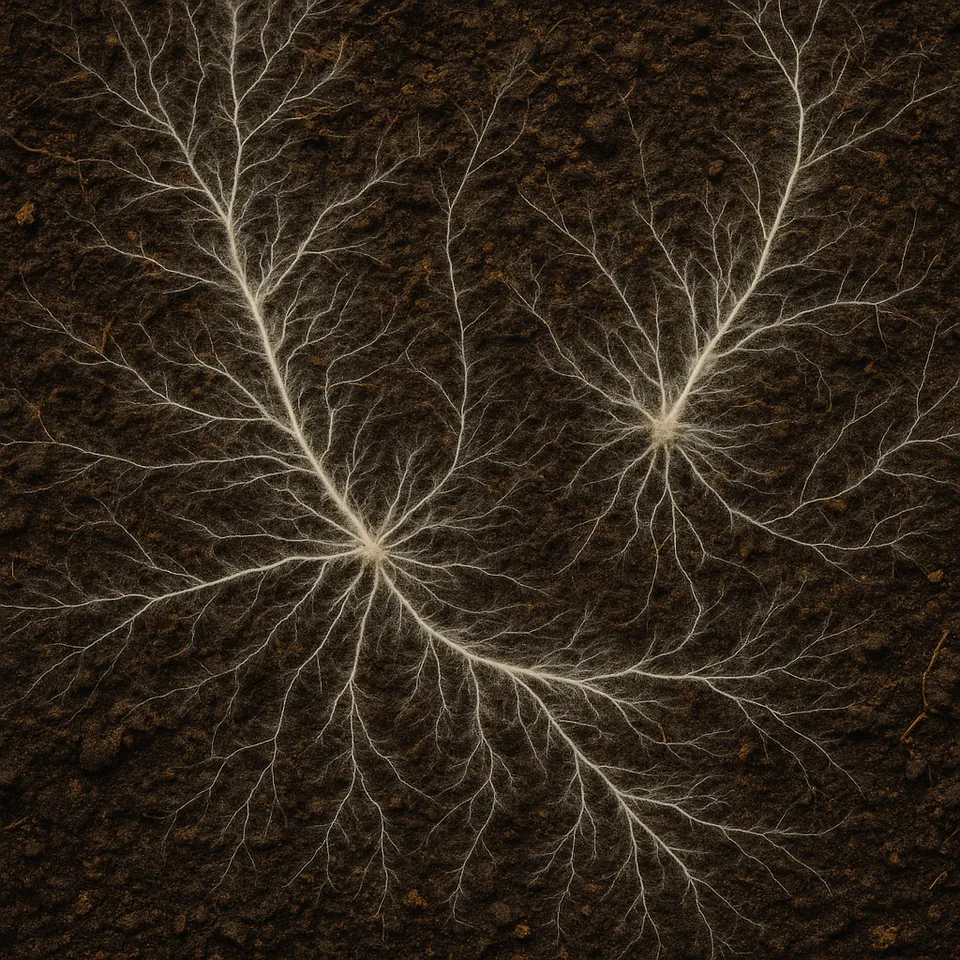
Connection before spectacle
A mushroom is often only the fruiting structure of a much larger fungal organism. Mycelial threads move through soil, wood and other material, helping decompose, recycle and exchange.
This chamber is not an edible-mushroom shortcut. Look first at habitat, substrate, season and structure. Keep facts, uncertainty and metaphor in separate rooms.
Life, simplified
This flow is a teaching sketch. Timing and form vary widely between fungal groups.
A reproductive cell that can travel on air, water, animals or disturbance.
If conditions allow, the spore begins to grow rather than remaining dormant.
Fine filaments that explore a substrate and digest what they can use.
The living network of hyphae. This is usually the main body of the fungus.
The visible mushroom, bracket, crust or similar structure that can release spores.
New spores leave. The mycelium may continue unseen.
A living pattern
Roles overlap. One species may change relationship over time. Forests are not one conscious wood-wide web, and not every fungal link helps every tree.
Many fungi break dead organic material into forms that can move again through soil, plants and other organisms. Decay becomes continuity rather than disappearance.
Some fungi form interfaces with plant roots. Carbon, water and minerals can move across that partnership. The exchange is real; it is not a guarantee of benefit to every plant in a stand.
Some fungi live at a host’s expense or exploit weakness. That can damage a tree or plant, and it can also open space for later species.
Other fungi live inside plant tissues with effects that are still being mapped: sometimes neutral, sometimes protective, sometimes costly depending on context.
Read the place first
One feature is never enough for safe identification. Do not taste unknown fungi.
Soil, living wood, dead wood, leaf litter, dung or buried roots.
Nearby trees and plants. Association can support a guess. It never proves identity.
Woodland type, leaf litter, moisture and recent weather all change what fruits.
Date, solitary or clustered, ring or troop. Calendar is a hint, not a key.
Shape, colour, texture, margin and how those change with age.
Gills, pores, teeth, folds or a smooth surface. Look without stripping the site.
Whole stem, ring or veil remnants, and the base. A volva, where present, matters.
Bruising, colour shift, texture and an optional spore print. A single photograph is incomplete.
Britain and Ireland, broadly
Species and weather matter more than the calendar. These are observation notes, not a fruiting guarantee.
Spring
Early fruiting, morels and saddles on some soils, and wood-inhabiting fungi after winter wet. Look at stumps, standing deadwood and shaded banks.
Summer
Dry spells suppress many fruiting bodies. Rain and cool microclimates can bring sudden flushes.
Autumn
For many woodland species this is the most visible season. Still photograph habitat, not only the cap.
Winter
Brackets, crusts, jellies and tough fruiting bodies remain. Decomposition continues below the quiet surface.
Company
Some fungi show strong host habits. Others are generalists. A nearby oak never proves the name of the mushroom at its feet. Association is evidence, not proof.
Long-lived woodland structure with a wide fungal company, including mycorrhizal boletes and wood-decay brackets such as beefsteak fungus and chicken of the woods.
Dense shade and mast years shape litter and fruiting. Porcelain fungus is a strong beech associate. Association is a clue, not a verdict.
Often an early companion on poorer or disturbed ground, including much of northern England. Birch polypore, brown birch bolete and woolly milkcap prefer birch, and several fungi do not.
Conifer stands carry their own mycorrhizal and decay communities. Needle litter is a different substrate from broadleaf mull. Slippery jack and saffron milkcap are pine-side examples.
Another conifer host, sometimes sharing Suillus and other plantation fungi with pine. Host is still only one character.
Wet ground and river edges. Moisture and disturbance can matter as much as the tree itself. Blushing bracket is a frequent waterside companion.
Understorey and coppice structure. Look at the whole stand, not a single stem. Dead attached twigs often carry jellies and crusts.
Wet woods and stream sides. Alder has its own mycorrhizal company. Do not transfer an oak name to an alder root by habit.
Closer to home
Visible mushrooms are not automatically disease. Fungi are not always beneficial. No-dig is not always best.
Leaving some leaf litter and woody material supports decay communities. Compost is a managed version of the same work. Woodchip can carry its own visitors, including introduced stinkhorns.
Where it is safe and permitted, leaving some deadwood helps habitat. Avoid unnecessary soil disturbance when the ground is already working.
Fungal growth on living plants, stored food or building timber may need investigation. Honey fungus is a real plant-health issue. Reduce unnecessary fungicide use; do not ignore structural or plant-health problems.
UK field atlas
Search by name, host, habitat or caution. Filter by visible form, ecological role, substrate, season or tree company. Higher-caution specimens stay labelled. This is not a poison garden, and it is not a menu.
Opening the atlas…
Before you name it
A single cap from above is rarely enough. Photograph the place, then the parts. Where lawful and appropriate, document the base carefully. If collecting is not appropriate, leave it in place.
Show how it sits in the place: soil, wood, litter, moss.
Shape, colour, texture, scales, warts and the margin.
Gills, pores, teeth, folds or a smooth surface.
Length, texture, ring or veil remnants, colour change.
Without cutting it off. A buried volva is easy to miss and expensive to ignore.
The wood, soil, dung, mulch or litter it is actually using.
Company is evidence. It is not a proof.
If they are naturally present. Do not uproot rare fungi to complete a set.
Honesty about photographs
Sometimes a picture narrows the field. Often it does not. This atlas refuses to pretend otherwise.
Sometimes a good candidate
A typical fly agaric, a hoof on birch, or a mature stinkhorn can be a strong candidate. Candidate is not certainty, and it is never an edibility verdict.
Often not enough
White gilled mushrooms, brown boletes, and garden Agaricus usually need stem, base, habitat and more than one photograph.
Sometimes impossible without microscopy
Little brown mushrooms on wood, many russulas, and several crusts need microscopic characters. The atlas says so on those cards.
Sometimes DNA or specialist work
Honey fungus, chicken of the woods, morels and some brackets are complexes. A familiar name can hide more than one species.
Local only
Collect a better observation before using Shroom ID or another field guide. Nothing typed here is stored by ARC or sent anywhere. There is no automatic identification from these fields.
Identification
AI can organise notes and suggest candidate groups. It must not decide whether a wild mushroom is safe to eat.
Multiple photos of cap, underside, stem, stem base and habitat, plus substrate, region, date or season, nearby trees and specimen age.
Sorting observations, suggesting candidate groups, explaining terms, comparing visible features and asking for missing evidence.
Edibility, whether poisonous look-alikes are excluded, or whether anyone should consume a specimen.
External identifier
A third-party AI identifier is embedded below. Use the field note builder first if you can. ARC does not certify the result, and a name is not an edibility verdict.
Using the Mushroom Identifier sends the image and information to that external service. Photos submitted inside the tool are processed under the provider’s own terms. ARC does not control image retention or the provider’s model behaviour. The service does not currently publish a privacy policy at a stable public URL.
Loading the identifier. If the frame stays blank, use the full-page link. On a small screen, scroll inside the frame to the upload control.
Field practice
A local checklist. Copy or save it if you want a record. Nothing here is stored by ARC.
Reflection prompt: what is supporting this place that I cannot immediately see? This is observation, not treatment.
Optional and quiet
No voiceover. No autoplay. No medical claim. Nothing here is required.
Three to six comfortable breaths with a slightly longer exhale if that feels easy. No breath holds. No forcing.
Notice feet, temperature, texture, sound and contact with the place you are in.
Name one visible ecological relationship: shade, decay, moisture, a host tree, litter.
Stop extra input for one minute and watch what the environment is already doing.
Use the fuller practice above when you have a path and a little time.
Access and conservation
This is a short orientation, not a legal briefing. Do not assume you can collect mushrooms anywhere for personal use.
Collecting rules can depend on land ownership, permission, site designation and species protection. Public access is not the same as a right to take fungi.
Sites of Special Scientific Interest, national nature reserves and other designated land can have additional restrictions. Local byelaws and site notices take priority over a website.
Commercial gathering can be treated differently from casual observation. Do not scale a walk into a harvest.
Some fungi, including many waxcaps of unimproved grassland, are conservation-sensitive. Photograph and leave them. Do not strip a patch.
Keep the rooms separate
Metaphor is not scientific proof. Forests do not share a single mind, and mycelium is not a conscious internet.
Observable fungal biology and ecology: hyphae, fruiting bodies, decay, partnership, parasitism and lichen partnerships can be studied in the field and the lab.
Network dynamics, signalling, exchange rates, species limits and what a photograph can settle remain active research. This atlas names that limit on the card.
Mycelium as an ARC image for connection, decentralisation, resilience and hidden support. Useful as language. Not evidence.
Field ethics
Follow local access and conservation rules. This is not a legal briefing.
Learn further
These organisations publish primary collections, field communities or woodland-ecology research. Read them on their own terms. Specimen cards cite Wikipedia, NBN Atlas and First Nature where those pages exist, plus specialist sources where needed.